Which VAT Category Code Carries Each Norwegian Rate in an EHF Invoice
Norway's 25%, 15%, 12% and 11.11% rates all carry one VAT category code: S. The rate belongs in the percentage field, and inventing a code fails BR-CL-17.
Read ArticleNews, engineering notes and regulatory insights on Peppol, PINT, and continuous transaction controls — from the team that runs your certified Access Point & SMP.
114 articles
Norway's 25%, 15%, 12% and 11.11% rates all carry one VAT category code: S. The rate belongs in the percentage field, and inventing a code fails BR-CL-17.
Read ArticleYour shop order does not say the e-invoice was delivered. What each state on the order means, which ones need you, and how to reissue or resend from the order.
Read ArticleEHF Reminder 3.0, Forward Billing 3.0 and Payment Request 3.0 have no Peppol BIS Billing equivalent. What each is for, and the SMP opt-in each one needs.
Read ArticleNeither Australia nor New Zealand makes e-invoicing compulsory for a business. What that means for an online shop, its checkout and its business buyers.
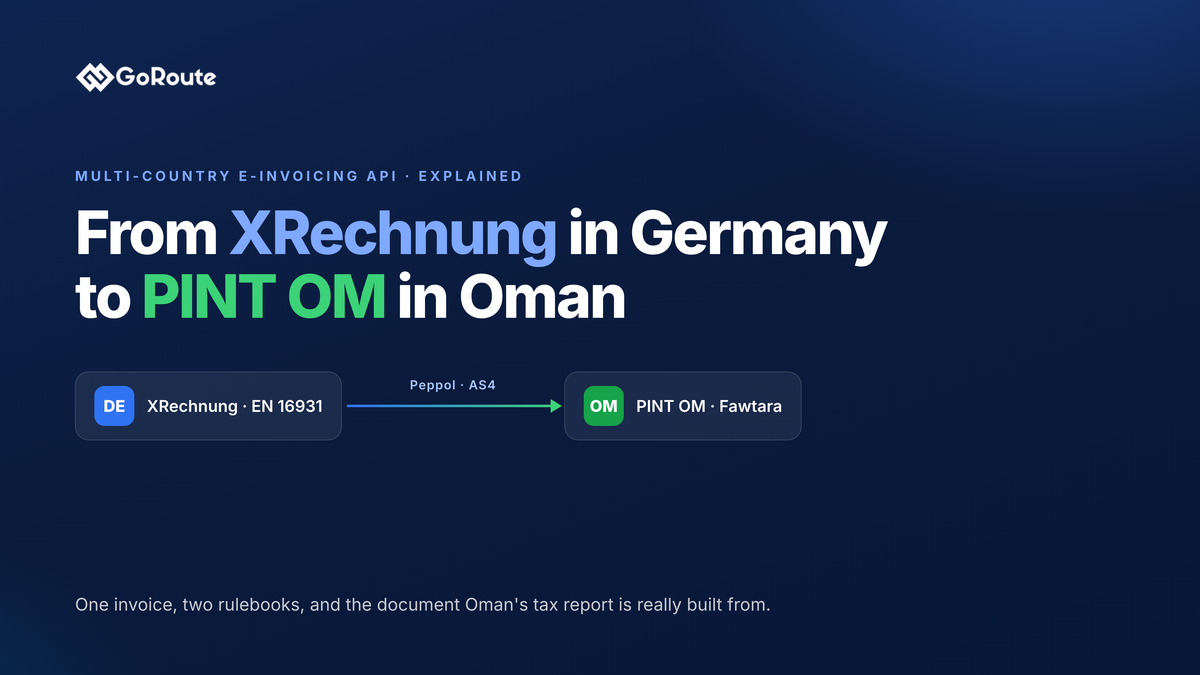
Read ArticleA German XRechnung invoice crosses Peppol unchanged, but Oman reports a self-billed PINT OM invoice built from it. See every rule it meets on the way to Oman.
Read ArticleA private Norwegian company does not register in ELMA. That registry is for public bodies; everyone else is published in a provider's SMP under scheme 0192.
Read ArticleGermany has required every domestic business to receive e-invoices since January 2025, and issuing starts in 2027. What both dates mean for an online shop.
Read ArticleSan Marino has two e-invoicing rules: cross-border trade with Italy via HUB-SM, live since October 2021, and a domestic mandate compulsory on 1 January 2027.
Read ArticleBelgium has required structured e-invoices between businesses since 1 January 2026. What that means for an online shop's checkout, its invoices and its refunds.
Read ArticleBelgium's B2B e-invoicing rule cuts both ways: your suppliers must send your shop structured invoices. What it takes to be reachable, and to read what arrives.
Read ArticleAn invoice from outside Oman cannot produce a tax data document, so your provider raises a self-billed PINT invoice instead and never sends it to the seller.
Read ArticleReceiving an Oman e-invoice is your provider's job, not your inbox's. What has to be registered, what format actually arrives, and who answers the sender.
Read ArticleSwitching Oman e-invoicing providers: the outgoing provider removes you from the SMP in one working day, the incoming one has three. How to control the gap.
Read ArticleThe GoRoute E-Invoicing Blog is written by the engineering, compliance and integration team behind a certified Peppol Access Point and Peppol SMP operated by ClayDesk LLC (Peppol ID POP000991). We cover the practical realities of Peppol BIS 3.0, PINT jurisdiction packs, and continuous transaction control (CTC) mandates — the kind of detail that helps finance, tax and IT teams actually ship.
Expect long-form, engineering-led guidance on Peppol onboarding, validation gates (UBL 2.1, EN16931, Peppol BIS 3.0, PINT), SMP registration, AS4 message exchange, Oman Fawtara / Tax Data Documents (TDD), European B2B mandates, DBNAlliance in the United States, and Finland's Finvoice network.
Looking for something specific? Browse by compliance, Oman, or jump directly to Global E-Invoicing, hosted infrastructure, or the developer sandbox.
Peppol is a pan-European e-invoicing framework used in 40+ jurisdictions. It standardises the exchange of structured invoices between Access Points using AS4 and UBL.
Learn about Peppol →A Service Metadata Publisher (SMP) advertises which documents a Peppol participant can receive, and where. GoRoute operates a managed SMP-as-a-Service with REST APIs.
Explore SMP service →Continuous transaction controls (CTC) require near-real-time submission of tax data to authorities. Oman's Fawtara and similar mandates sit on top of Peppol-based exchange.
See Oman Fawtara →